About Central Florida Gardener

Welcome and thank you for visiting Central Florida Gardener. Florida is a unique state in which to garden. It can be frustrating but also rewarding for gardeners who persevere. This blog was created as a resource for Florida gardeners, both new and experienced, in search of information specifically for Florida gardens.

You are invited to participate by leaving your comments, suggestions, tips and recommendations relevant to Florida gardening - don't be shy! Thank you for dropping by to learn more about gardening in the Sunshine state. I look forward to hearing from you! Susan

Monday, February 28, 2011

The Spring Vegetable Garden

In early to mid-March, once the threat of freezing temperatures is greatly reduced, warm-season crops can be planted in the garden. But, remember if you plant early...you may need to protect young seedlings if the temperatures drop.

Warm-season vegetables...those that will produce through mid-June (some longer) are:

Beans (bush and pole), corn, cucumbers, eggplants, melons, peppers, potatoes, yellow squash, tomatoes and zucchini.

Herbs:

Basil, dill, fennel, marjoram, Mexican tarragon, oregano and parsley.

Garden Tip: Rosemary is a great year round herb to plant in the garden...even if you don't cook with it. It doesn't freeze, it's fragrant and it makes a great looking landscape plant.

Planting seeds is most economical, but to harvest tomatoes before summer's heat and humidity arrive, you'll  need to start your seeds in pots the first two weeks in January, and bring them indoors to protect them from cold weather. If you're just getting started now, buy already established plants from a local nursery and plant directly into the garden.

Garden Note: You can still plant cool-season varieties such as: broccoli, carrots, lettuce and radishes that should produce into May (better to get them planted by February 15th). But, if you have limited garden space, you may want to stick with warm-season varieties for a longer harvest time.

 
To extend the tomato season into summer, try the new heat-resistant varieties available such as: Solar Set and Sunmaster, or plant some cherry tomato varieties which will do better during the hot months. My favorites are chocolate cherry, black cherry and sun gold.

For the total scoop on growing tomatoes in Florida see the University of Florida Extension's article: Tomatoes in the Florida Garden.

To the seasoned Florida vegetable gardeners...

What advice would you give to someone planting vegetables for the first time?

Thursday, February 03, 2011

A Bee-Friendly Garden


Indian Blanket Flower (Gaillardia)
 Many people may not think about the necessity of creating a bee-friendly garden, but bees are essential to the pollination of vegetable and flower gardens. And with their declining populations, it's worth the effort to make the garden more bee-friendly in an effort to attract a few more of these beneficial species into our own gardens.

There are 6 families of bees...each with numerous species...in Florida that work as pollinators for native plants, food production and in our gardens.

I wanted to find out more about making my own garden a little more bee-friendly, so I did a little research. If you're interested in having a more diversified, wildlife-friendly garden here are some tips that will make your garden an inviting bit of paradise to our Florida pollinators:

#1 - Don't use pesticides. Avoid pesticide use whenever possible as they kill off beneficial insects, as well. In circumstances when you need to use one, choose the least toxic product available.

#2 - Grow local native plants. Add a variety of native plants to all areas of your garden. Studies have shown that native plants are four times more likely to attractive native bees.

#3 - Plant blue, purple, white and yellow flowers. These colors are most appealing to bees and will attract a larger number of pollinators to the garden. Choose a variety of plants for blooms in all four seasons.

#4 - Choose flowers with different shapes - Generally, single flowers attract more bees than double petals which don't produce as much pollen and nectar. But long-tongued bees and bumblebees love to dine on tubular shaped flowers...to ensure that you provide food for a variety of bees, plant flowers with a variety of shapes.

#5 - Place bee-loving plants in clumps. Planting clumps of one species together will attract more bees than placing a single plant in different places around the garden.

#6 - Provide year-round blooms. Make sure you have flowers in your garden year round, especially in winter.

#7 - Be a little less tidy in the garden - Bees need natural materials to construct nests. Leave dried grasses through the winter and small brush piles hidden in the garden for this purpose. Also, leave some unmulched ground so that ground-nesting bees can construct their nests.


I noticed this past summer that two particular plants in my garden...liriope (both Big Blue and Evergreen Giant), and Moss Rose were attracting large number of bees on a regular basis. Also, the native mallow (most people would call it a weed) that I let grow in parts of my backyard while it's blooming (photo on right) is another favorite.


What plants in your garden are the bees most attracted to?

Thursday, January 13, 2011

More Cold-Hardy Plants

Here we go again...another unseasonally cold winter with one cold front after another. Two new plants added to my garden this year were surprisingly cold-hardy in our recent low temps in the upper 20's: Abutilon (Flowering Maple) and leopard plant.


Joe Parr, Director of Horticulture at Busch Gardens discovered our cold-hardy plant list, and added a few more plants to the list we all created last winter:  Blue Victoria salvia and citrona. He also mentioned that his established gingers fared much better than newly planted ones. This may be a clue for us to get sub-tropical plants in the ground early enough for them to become well established before winter arrives.

If you've got new plants in your garden that fared well this winter, please add them to our cold-hardy plant list. And again, many thanks to all of YOU who created this list. I have referred to it many times this past year when adding plants to my garden.

Thursday, January 06, 2011

FNGLA 2011 Plant Selections

Snow Princess
Photo credit:
Provenwinners.com
Every year the Florida Nursery, Growers and Landscape Association (FNGLA) chooses a selection of Florida's best plants. These plants are chosen for several reasons...one being their success in growing in our diverse Florida climate.

For 2011 the six "Florida Garden Select Plants" chosen were:

* Gold Medallion Tree (Cassia leptophylla) - This cassia has yellow blooms in early summer and can survive temperatures into the mid to low 20's. That definitely sounds promising considering our winters lately.
* Prostrate Yew or Japanese Plum Yew (Cephalotaxus harringtonia 'Prostrata') - This low growing shrub  has dark green leaves similar to a conifer.
* Caranday Palm (Copernicia alba) - This palm tree for zones 9b - 11 has silver-green fronds and can grow up to 50 feet tall.
* Snow Princess (Labularia hybrid 'Snow Princess') pictured above - An annual in other parts of the country, white blooms cover this mounding plant, and is perfect for hanging baskets.
* Yellow Butterfly Pea Vine (Cailaeum macropterum (formerly Mascagnia macroptera)) - This Mexican native sports 1" yellow cascading flowers. It grows up to 15 feet tall and is heat-loving.
* Wire Vine (Muehlenbeckia axillaris) - a small, glossy green-leaved groundcover.

These plants are available for purchase at your local garden center. Now you can also keep up with the FNGLA by becoming a fan at Facebook.

Click here for photos and more information on these plants.

Monday, November 29, 2010

Are the Hummingbirds Still Here?

I just read a fascinating article, The Hummingbirds of Winter*, in the National Wildlife Federation's December/January issue. According to Bob Sargent, who runs the Hummer/Bird Study Group, "There's no truth to the myth that keeping a feeder up after Labor Day will stop hummingbirds from migrating."

For as many as 15 years now, hummingbirds have been spotted along the Georgia and Carolina coasts during the winter months. In an effort to try and answer numerous questions regarding the hummingbirds, Fred Bassett who heads up the nonprofit Hummingbird Research, Inc. has been banding the birds. To this date, he has banded almost 2,000 hummers of 10 different species in backyards from Mobile Bay (in Alabama) to Tallahassee and as far south as Tampa. Almost half of the banded birds have been rufous hummingbirds (pictured above) which nest in the Pacific Northwest and Alaska.

So, if you leave a sugar-water feeder out during the fall and winter months, keep an eye out for hummers in your backyard. The Hummer/Bird Study Group is requesting that you notify them of any sightings at rubythroat@aol.com.

I see lots of hummers during the summer, but can't say I've ever seen one in the winter. Have any of you seen one in your garden?

*Note: I always have trouble getting the NWF.org website to load. If you can't access that article, you may want to Google "The Hummingbirds of Winter."

Thursday, September 02, 2010

Three More Florida Garden Bloggers

Yippee! ** Here's a few more Florida garden blogs to add to the mix:

Serendipity in the Garden - A Florida native gardening in West Central Florida.

The Good Garden - Sarah's "good garden" is located in Orlando.

Chars Gardening - Charlotte is documenting the creation of her new garden in Navarre in her recently new blog.

Oh, I can't believe I overlooked my new garden blogger friend Brando in the Tampa Bay area:  A Ponderer Digresses Please forgive me Brandy!

This blogging thing is really catching on! :-)

Monday, June 14, 2010

Florida Yards & Neighborhoods Program

The Florida Yards & Neighborhoods Homeowners Program was developed by the University of Florida IFAS Extension in an effort to teach homeowners how to create a beautiful landscape that conserves water and reduces pollutant runoffs, while saving time, energy and money. Sounds like a great program, and it is!
The program, in a nutshell, consists of 9 major principles:
* Right Plant, Right Place
* Water Efficiently
* Fertilize appropriately
* Mulch
* Attract Wildlife
* Control Yard Pests Responsibly
* Recycle
* Reduce Stormwater Runoff
* Protect the Waterfront

The program provides educational information, including workbook, articles, newsletters and workshops geared to educate and enlist homeowners in the ongoing battle to preserve our natural resources, and work in tandem with nature in our Florida yards. 

Florida Friendly Yard certifications are available for homeowners who use environmentally-friendly practices. By meeting the minimum requirements of the program, homeowners are recognized for their contribution to the state and awarded a sign for their yard and a certificate.

Most people think that Florida-Friendly landscapes are not attractive, but that is not true. Check out these photos to gather ideas for your own yard.

For more information, visit your county's web page for additional information on the program that is suitable for your area. 

Wednesday, May 05, 2010

Taking Better Pictures in the Garden: Part 3

Alright. Where were we?
Oh yes.
Another feature that's available on most mid-level cameras is white balance control. You know, light comes in all sorts of colors and our eyes naturally adjust to recognize white is, well, white under all sorts of different lighting conditions. But in the shade, white is actually kind of blue. And under incandescent lights it's a little bit yellow. Fluorescent lights? Whoo. I don't even wanna go there.
Your camera isn't smart enough to know the difference.
But you can tell it to compensate for the colors different lighting conditions cast by using your white balance control. Most cameras have settings for shade, clouds, full sun, incandescent (or tungsten), and fluorescent light conditions, along with an AWB or auto white balance option.
As always, consult your camera's manual to see where the options are located on your particular camera. But I thought I would show you the same scene, shot with different white balance settings so you can see the difference. Aperture and shutter speed remained pretty much the same.

For this first shot, the white balance is set to Tungsten/Incandescent. The camera supposes that the light will be yellowish, so it compensates by adding blue.

My mid-level camera offers a couple of different Fluorescent settings. This one looks kind of purple-y. Yuck.

And here's the other Fluorescent setting - a little on the pink side:

This one was shot with the white balance set on Cloudy. Kinda yellowish, huh?

This time, I set the white balance to Shade and the camera added a lot of yellow. A lot.

Here, the camera is set to Auto White Balance, which did a pretty good job:

And here is the correct white balance, Daylight:


You can also use your white balance for creative control. Adding the blue tone of the tungsten setting can make a picture look a little spooky. Shooting with your white balance set on cloudy or shade really makes the colors richer - sometimes a little too rich, but hey. Get creative. Whatever.

And here's a fun little trick that point-and-shoot users and mid-level camera users can both enjoy (and really, advanced camera users can too I guess). Most cameras have a few built-in settings - modes that you can select to take better pictures without having to think about it. Mine offers a portrait mode, landscape mode, flower mode, night mode and a couple of other options. But for the purposes of taking pictures in a garden, I thought we'd have a little fun with landscapes and flowers.
Shooting in landscape mode will give you nice, wide shots and usually richer blues and greens.


I have not edited these photos in any way. I wanted you to see what a nice job your camera can do just by selecting a pre-set mode.
You also might want to try your flower mode.

Even if you like taking pictures of plants that aren't flowers, you might want to try your flower mode.


But personally? I like the macro setting better. Flower mode pretty closely resembles macro in lots of ways, but I think macro does a better job of giving detail and perspective with a shallow depth of field.


So, go. Go on, now. Get outside. Take some pictures. Give your camera some love.

Monday, April 26, 2010

Taking Pictures in the Garden: Part 2

Hi everybody! It's Christy - I'm back with another post about using your cameras to the fullest! First of all, thanks so much for your kind comments. I'm kind of a comment-a-holic. They really make my day. Seriously.

This time around, we are going to talk about mid-level cameras. Some people call them hybrid cameras, because they combine the ease of point-and-shoot cameras with a selection of the features from professional-type DSLR cameras.
I went to our lovely, local public garden to shoot pictures for this post and realized that really, there is too much information and I took too many pictures (!), so I'm going to split it up into two posts - aperture and shutter speed today and some tweaks and fun buttons tomorrow. K?
Alright.
Aperture and shutter speed both control the amount of light that comes into your camera. It used to be about how much light the film was exposed to, but now it controls the light that reaches your digital camera's sensor.
Let's start with aperture. I want to keep this pretty simple here, so if you want more information, follow that link, buy a book, or take a class. It's way more fun and authors and teachers know more than I do. I promise.
Basically, "aperture" refers to how wide your camera's, uh, eyelid opens when you click the shutter. It's measured in "f stops" and on mid-range cameras, you are likely to see aperture ranges from F2.8 to F8 or F11. But here's the tricky part: the higher the number is, the smaller the opening is. I know, right? It doesn't seem to make sense. The main thing you need to know about aperture is a low f-stop (low number) lets in more light. So, if I were taking pictures in the sun, I'd want a high number and if I were taking pictures in the shade, I'd want a lower number.
Got that?
With a mid-level camera, you now have some (read: limited) control over your camera's aperture. You can adjust this number if you have your camera set to "aperture priority." In aperture priority, you select the aperture and the camera automatically adjusts everything else (very polite, yes?). My camera has a dial on top, and the setting is "A." Some cameras have "Av." Use your manual to figure out how to change the f stop. Play around with it and see what happens. My little Fuji S8000fd has a decent range of aperture settings - from F2.8 to F8.
The other thing that your aperture controls is your depth of field. You know how some pictures have the subject in focus and everything else is nice and blurry? I like those kind of pictures a lot. You can use your aperture controls to achieve that effect. Here is the same flower, shot at two different f stops:
This one is f8
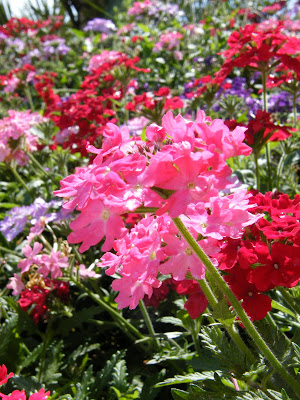

and this one is f3.5
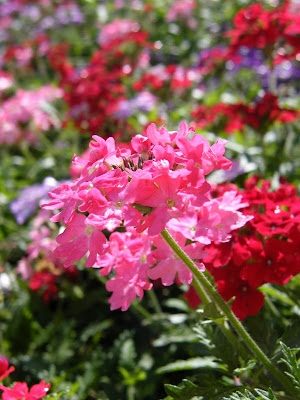

The difference is pretty dramatic, don't you think? It would be more dramatic if I could gone all the way down to 2.8, but that let in so much light that the flower had crazy, eye-piercing, glowing white highlights. Nobody wants to see that.


Shutter speed, well, it's pretty self-explanatory, right? Not so fast. It doesn't actually refer to how fast your shutter is, but to how long your shutter stays open. Again, adjusting your shutter speed controls how much light your sensor is exposed to, but it also controls how you capture motion. If your shutter speed is too slow and your subject is moving - even slightly - your pictures will be blurry. Think bamboo on a windy day. That could really be blurry.
Sometimes blur is good, though. It conveys motion. Spokes on a bike wheel should be blurry, right? Otherwise, the bike might just be parked with some helmeted dude sitting on it, as far as you can tell from the picture.
So, shutter speed can be kind of a creative control. You decide what you want to convey to your viewers. Shutter speeds on my mid-level camera ranges from 4 seconds to 1/2000th of a second. Obviously, 1/2000th of a second will freeze motion right in its tracks. But if I'm in the shade or inside my house, it's definitely not going to let in enough light to see the subject of my photo. Four seconds will make any motion at all blurry, but will let in lots of light. Lots of it.
You can shoot in "shutter priority" on your mid-level camera, just like you can shoot in "aperture priority." You select the shutter speed and the camera figures out the rest. On my camera, I set the dial to "S," but on others it's labeled "Tv." Go figure.
I spotted a fountain that could perfectly demonstrate the use of shutter speed - the water is constantly in motion.
Here's the fountain at 1/200th of a second:
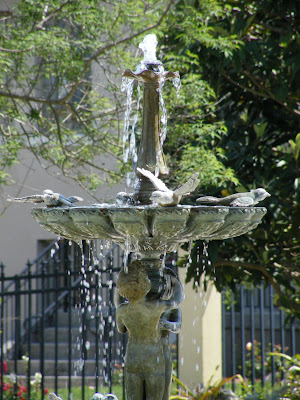
I mean, it's sort of a pretty picture. Obviously, the water is moving. I can tell what's going on here. But it's a little washed out and I'm not sure I like overall look of this photo.
Here is the same fountain shot at 1/1000th of a second:
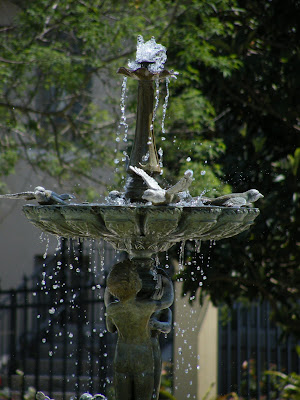
The drops are nearly frozen in place. It's still obvious that the water is in motion because, well, water doesn't just hang out in mid-air like that. But the colors of this one are richer, and even though I'd prefer to lighten it up a bit and fix a few things with some editing software, I like this photo much better.
One more note about shutter speed: you probably will not have fractions listed as options to select. the numbers move from 2000 (which is really 1/200-th) backwards to 0.3 and such, and then up to 1, 2, 3, etc. I hope that makes sense. It likely will if you pull out your camera and start messing around with your shutter speed.

As you begin to shoot in aperture priority and shutter speed priority, you will find that there are some things your camera just won't do. If I want to shoot at F2.8 in aperture priority and I am outside in the sun, my camera will flash a red warning telling me that it can't set a shutter speed fast enough to compensate for how much light the wide aperture is letting in. I could go ahead and take the picture anyway, but it probably won't be a good one. Each camera has its limits.
I hope this begins to give you an idea of how shutter speed and aperture work together. Actually, combining the two of them and understanding how they work together is the key to shooting in "manual." But we'll save that for another post.

I apologize for the wordiness of this post. These are two major concepts in photography that deserve more than a couple of paragraphs. If you have any questions, if any of this doesn't make sense or if you now want to run and hide under your blankets and never see a camera again, let me know in the comments. I'll try to fix it. I promise.
I also promise way more pictures in the next post!

Friday, March 26, 2010

Taking Pictures in the Garden: Part 1

Hey everybody! My name is Christy and I'm a friend of Susan's - our daughters go to school together. Susan has invited me to share a series of posts with you, her fabulous readers, about taking better pictures in the garden.
Now, before we get too far into this, let me make it clear that I am not a professional. I don't belong to any associations and I haven't won any awards or been published anywhere that sounds impressive. I just love to take pictures! My interest has led me to take a couple of classes and over the years I've moved from simple point-and-shoot digital cameras to more complicated models. Currently, I am in love with my new Canon 50D. She's my baby. I take her everywhere in a pretty little bag with a matching, handmade camera strap. "Pretty" and "matching" count for a lot in my little world.
Ahem. Let's move on.
I figure that lots of you out there are taking your pictures with point-and-shoot digital cameras. Some of you may have invested in mid-level cameras and a few of you have probably really invested in cameras with lots of buttons and you don't know what to do with them. So, I'd like to start at the bottom and work our way to the top, okay?
Okay.
All of the pictures in this post were taken with an ancient Olympus point-and-shoot 4 megapixel camera (!) and I aim to prove that even with an ancient camera that you're embarrassed to show to your friends, you can take better pictures than you are now!

Tip # 1: Turn off your flash!
Somewhere on your camera, you will see a little icon that looks like a lightning bolt or maybe a zig-zaggy arrow. Push that button! It might seem that, if you're shooting in the shade you need the extra light, but trust me - you probably don't. The camera's flash will probably give you ugly, harsh shadows and eye-cringing highlights that detract from the beauty you are trying to capture. Case in point -
Azaleas with flash:


Azaleas without flash:

Much prettier!

Tip #2: Try your macro setting.
This button probably looks like a little tulip or some other kind of flower. This is because your macro setting is great for taking pictures of flowers. Seems obvious now, doesn't it? This setting allows your camera to focus on a subject at a much closer range and, while bringing your subject into focus, will blur out unnecessary background details.

Regular setting:


Macro setting:


I really like how that rose turned out!

Tip #3: Make the most of the lighting conditions.
Gardeners all know that different places in your yard have different lighting conditions. We all plan and plant accordingly. Sunlight can affect your pictures just as much as it does your garden. Before you take that picture, take a minute to observe how the light affects your subject. Direct sun can create harsh shadows, just like your camera's flash does.
I really loved these collard greens at Susan's house, but I hated how the sunlight was making parts of the leaves blindingly white and parts of it covered with hard shadows.

So I moved in a little closer, hoping for a better angle. I really liked how the plant filled the frame on this shot - maybe it's just me, but I think it looks like a green, textured rose.

But I still think the light is too harsh. It still makes my eyes hurt a little.
So, I moved around to observe how the light was affecting my subject. Then I noticed that, from below, the light was shining through the leaves and making them glow.

Now, I really liked how the shot was framed on the previous one, but I love what the light does to the plant at this angle, and I think it's my favorite of the two. This is just a matter of personal preference.
But that little exercise brings me to my next tip -

Tip #4: Move around your subject.
My photography professor likes to say that people tend to "plant" their feet in front of a subject and just start shooting. If you do that, though, your pictures will look like everyone else's!
Susan has an adorable grouping of pots on her back porch (remember those free ones from a few posts ago?) and I wanted to take a picture of them. So I did - I took one from where I was standing.

Hm. It's really lacking something, isn't it? So, I tried getting down at eye-level with the grouping.

I like that, from here, you can see the little bunny's smile.
Here's another series of photos to demonstrate how moving around the subject and trying different things can give you very different photographs of the same subject.


And as you continue to move around and try different things, you are likely to settle on the "money shot" - the one you really love. It rarely happens with the first snap of the shutter for me. I usually take several shots before I really come up with the one I love and I am guessing the same will be true for you too. Here's what happened right at the end of this series:

This was my favorite shot from the whole morning!

A few other basic tips:
Your camera's manual is your best friend! Every camera is different. The buttons do different things and are located in different places. Read it and try out the tricks your camera can do.
Seriously. Just get out there and take pictures! Don't wait until the weather or the lighting is perfect or until you have the camera of your dreams. Great pictures can be taken with the simplest of cameras. It's really all about capturing your unique view of the world.
Try some photo editing software. There are lots of free ones like Picasa and The Gimp. Like I said, I shot all of these pictures with a very old, basic camera. I didn't really like how a lot of them turned out - especially in the shade, where they all looked a little blue to me. I took one that was pretty blue and did a very basic color correction in The Gimp. Check it out!
Before:

After:

There is really so much more that we could talk about, but there's a lot of information in this post. I'll be back with a post about shooting with mid-level digital cameras and, if nobody's thrown any rotten tomatoes by then, a final post about DSLRs.
Thanks for listening to me ramble about doing something I love. Now, get out in your yard and take some pictures!

Tuesday, March 16, 2010

Floridata -- Photographic Plant Encyclopedia


Floridata is an online photographic plant encyclopedia created for Florida gardeners by Jack Scheper 10 years ago. Along with 10 gardening friends/contributors he maintains a database of 730 plus Plant Profiles/Lists from annuals to vines, and everything in between. It’s a great resource for researching potential plants for your garden.


Jack has created an invaluable resource for Florida gardeners. Floridata gets my vote as one of the top resource sites for Florida gardeners. If you’ll remember, Jack was generous enough to let me link our cold-hardy plants list to his plant profiles.

Here’s what you’ll find at Floridata:

Plant Profiles/Lists

* Plants are listed alphabetically by botanical name.

* Plants are categorized by Plant Tag Lists - 9 types of plant categories: annuals, grasses, palms, perennials, shrubs, trees, water plants and cactus/succulent.

* The lists organize plants by some special feature or characteristic (such as edible, fragrant, drought, tolerant, etc.).

Note: One of my favorite resources on the homepage are links to these “special feature” lists. It’s easy to click on “Fragrant Plants” or “Shade Plants” and find a list of plants with these features.

In addition to Plant Profiles, Floridata features articles and other resources.

* Photo galleries: azalea, butterfly, camellia, pepper, Florida scrub plant, Florida scrub endangered plants, animals of the Florida scrub.

* Butterfly Resources - life cycle, photo gallery of 45 species, plants that attract butterflies.

* “How to” Articles written by Florida garden experts.

Member Profile & Forums provide a way to connect with other Florida gardeners.

* As a gardener, you can create a Profile Page that includes information on your garden. Create your own plant lists, and include a link to your blog,

* Forums and discussion groups are available for members to participate in.

When not working on Floridata, Jack maintains his own online garden journal - Jack’s Gardener’s Journal - where he writes about his experiences in his garden - Floridune near Tallahassee.

Steve's Annual Hurricane Lily Sale

Spider Lilies for Sale!

It's time for Steve's annual hurricane lily (Lycoris radiata) sale. They are 50 cents per bulb plus postage with a minimum of 20 bulbs. Email Steve at chrstmn@yahoo.com for more info.

Steve Christman is a contributor to Floridata’s Plant Profiles. Find our more about Steve at Floridata.

Monday, March 01, 2010

Caladiums


If you're looking to add long lasting, low maintenance summer color to your garden...caladiums are a sure bet.

Caladiums are grown from tubers. There are several grades of tuber or bulb sizes available, but the large tubers produce plants with larger leaves.

Two types of caladiums are available...fancy leaved and lance or strap leaved. The leaves are heart shaped and come in a variety of colors and markings.

The University of Florida recommends that you plant the bulbs in mid-April in the central Florida area. They are available now in local nurseries or you can order them directly from the growers in Lake Placid. If you plant large numbers of bulbs, you will most likely want to order from a mailorder source for better pricing.

Two Lake Placid mailorder sources that begin shipping the first of March are:


It is my experience that bulbs sold in the local nurseries sell out quickly in the spring, so now's a great time to purchase the bulbs for planting next month.

Traditionally planted in the shade, these bulbs are field-grown in full sun in Lake Placid, Florida...the Caladium Capital. Most varieties perform better in shaded locations, but many varieties will tolerate full sun. The University of Florida's Caladiums as Potted & Landscaped Plants article provides good information on selecting and planting caladium bulbs, as well as a chart that specifies shade and sun varieties.

My neighbor has a large bed of all white caladiums growing in front of a dark green hedge on the side of their house. This large display of a single variety is stunning from April through October. It creates a calming and cooling effect in the landscape, and the simplicity of this area is fabulously beautiful. Everytime I drive by their house, my eyes are drawn to this area...it's just beautiful!

Tuesday, February 16, 2010

Growing Green Festival Update

Kimberly at Garden in Paradise attended the Growing Green Festival 2010 in Stuart. Click here to read her post on the festival. She's included lots of great photos, and it looks like she had a great time and learned alot.

Wednesday, February 03, 2010

Cold-Hardy Plants List

A BIG thank you to all of you who participated by submitting the lists of “survivors” in your yards. Our list of cold-hardy plants range from Jacksonville to Ft. Lauderdale, and from gardeners on both the east and west coasts.

In compiling the list, here‘s what I‘ve done:

#1 - The majority of the plants listed are the most cold-hardy for the central part of the state. However,  some of the plants you'll see listed under "tropicals" may have done well for some gardeners due to micro-climates -example: under trees, up against homes, near water, etc.

#2 - The plants are listed by category - from annuals to vines

#3 -  Each plant is linked to a Floridata Plant Profile page that contains more information about it (there are a few exceptions). NOTE: A BIG thank you to Jack at Floridata for graciously granting his permission to allow me to do this. The ’plant profiles’ provide a bounty of information. Watch for an upcoming post on Floridata - an invaluable website for Florida gardeners.

#4 - All native plants have an asterisk * behind the name.

#5 - The county or town of the person who reported the plants/trees is listed beside each plant. I was going to report each person’s name, but settled for town and county in an effort to save space.

All the generous Florida gardeners that took the time to submit their ‘survivors’ are listed at the end of this post. Again, thank you to each and everyone of you for taking the time to send me your lists (and, if I’ve neglected to list someone, please let me know and I’ll make the correction a.s.a.p.). If you haven’t submitted a list but want to, it’s not too late. Leave a comment on this post, and I’ll add your plants to the list.

The list turned out GREAT! I’ve been gardening for a long time in Florida, and I was surprised at how many wonderful cold-hardy choices we have, especially when it comes to perennials...43...can you believe it? Altogther, there are a total of 150 plants in 16 different categories. I have a feeling we'll all be busy adding new plants to our gardens this spring.

Now, here's the list:

Annuals/Biannuals (6)
Alyssum  'Lobularia maritima' (N.Hillsboro)
Dianthus 'D. barbatus' (Polk)
Dusty Miller  'Senecio cineraria'  (Orlando)
Pansy and Viola ' Viola x Wittrockiana' (Orlando, NW Hillsboro)
Petunia 'Petunia x hybrida' (Orlando)
Phlox 'Phlox drummondii'  (Orlando)

Bamboo (1)
Multiplex Fern Leaf  ' Bambusa multiplex' (South Tampa)

Cycads and Palms (10)
Everglades* 'Acoelorrhaphe wrightii' (Jax)
Hardy Bamboo palm 'Chamaedorea microspadix' (Jax)
Needle* 'Rhapidophyllum hystrix' (S.Hillsboro)
Pindo 'Butia capitata' (Lake, Polk)
Ponytail 'Beaucarnea recurvata' (Treasure Coast)
Queen 'Syagrus romanzoffiana' (Polk)
Rhapis Lady 'Rhapis excelsa' (S.Hillsboro)
Sago 'Cycas revoluta' (Lake, Polk)
Saw Palmetto ' Serenoa repens' (S.Hillsboro)
Stemless Cluster Palm 'Chamaedorea radicalis' (Jax)

Ferns (3)
Bird’s Nest 'Asplenium nidus' (Polk)
Holly 'Cyrtomium falcatum '(Polk, N.Hillsboro)
Rabbits Foot 'Davallia trichomanoides' (Polk, NW Hillsboro)

Fruit (10)
Blackberries 'Rubus fruticosus' (Lake)
Blueberries 'Vaccinium ashei' (Lake)
Fig 'Ficus carica' (Polk)
Loquat 'Eriobotrya japonica' (Jax)
Orange  'Citrus sinensis' (Lake, Polk)
Meyers Lemon 'Citrus meyeri' (Lake, NW Hillsboro)
Peaches (P olk)
Plums (Lake)
Ponderosa Lemon 'C.limon ×C.medica'  (Treasure Coast)
Pineapple Guava ‘Feijoa sellowiana (Jax, Lake, Orlando)


Grasses (4)
Blue-eyed*'Sisyrinchium angustifolium' (N.Hillsboro)
Gamma *'Tripsacum dactyloides' (N.Hillsboro)
Juncus 'Juncus effusus' (N.Hillsboro, South Tampa)
Muhly 'Muhlenbergia lindheimeri' (N.Hillsboro)

Groundcovers (7)
Ajuga 'Ajuga reptans' (Lake, Polk)
Amazon Lilies 'Eucharis grandiflora' (Orlando)
Cast-iron 'Aspidistra elatior'(Lake, Polk)
Coontie *'Zamia pumila' (Lake,N.Hillsboro, Polk)
Gold Mound Sedum (Lake, N.Hillsboro)
Liriope 'Liriope muscari' Various varieties (Jax, N.Hillsboro)
Purple Queen 'Tradescantia pallida' '(N.Hillsboro)

Herbs (6)
Allium ‘alba’(N.Hillsboro)
Chocolate Mint (N.Hillsboro)
Oregano (N.Hillsboro)
Parsley (Polk, N.Hillsboro)
Rosemary (Lake, N.Hillsboro, S.Tampa)
Spearmint (N.Hillsboro)

Perennials (43)
African Bush Daisy 'Gamolepis chrysanthemoides' (Polk)
African Iris 'Dietes iridioides' (Lake, N.Hillsboro, Polk)
Agapanthus  'Agapanthus spp.' (Lake, N.Hillsboro, Polk)
Agastache Black Adder (N.Hillsboro)
Beautyberry* 'Callicarpa americana' (Lake)
Belladonna Lilies (Polk, N.Hillsboro)
Black and Blue Salvia 'Salvia guaranitica' (N.Hillsboro)
Blackberry Lily (Polk)
Blue Sage 'Eranthemum nervosum' (Lake, Polk)
Brazilian Iris 'Neomarica caerulea' (Lake)
Brazilian Plume 'Justicia spp.' (Lake)
Bulbine 'Bulbine frutescens 'Hallmark' (Lake, N.Hillsboro, NW Hillsborough)
Candy Lily (N.Hillsboro)
Coral Bean* 'Erythrina herbacea' (N.Hillsboro)
Coral Reef Sedum 'Sedum tetractinum 'Coral Reef' (N.Hillsboro)
Crocosmia 'Crocosmia X crocosmiiflora' (Melbourne)
Daylilies  'Hemerocallis hybrids' (Treasure Coast, Polk, N.Hillsboro)
Echinacea  'Echinacea purpurea' (Treasure Coast)
Fariy Fan FlowerScaevola aemula’ (NW Hillsboro)
False Blue Ginger 'Dichorisandra thyrsiflora' (N.Hillsboro)
Flag Iris'Iris pseudacorus' (Lake, Polk)
Flax Lily 'Dianella tasmanica varigata' (Polk, N.Hillsboro)
Gaura 'Gaura lindheimeri' (Lake, NW Hillsboro)
Goldenrod* 'Chrysoma pauciflosculosa'  (N.Hillsboro)
Horsemint* 'Monarda punctata' (Melbourne)
Hurricane Lilies ' Lycoris radiata' (N.Hillsboro)
Indian Blanket* 'Gaillardia pulchella' (Polk, N.Hillsboro, NW Hillsboro)
Lamb’s EarStachys byzantina’ (Polk)
Louisiana Iris 'Iris Louisiana hybrids' (N.Hillsboro)
Mexican Petunia 'Ruellia brittoniana (N.Hillsboro)
Mystic Spires Salvia 'Salvia Mystic Spires Blue' (Lake, N.Hillsboro)
Orange Bird of Paradise 'Strelitzia reginae’ (Polk, Melbourne)
Pineapple Sage 'Salvia elegans' (Lake) 
Plumbago 'Plumbago auriculata' (N.Hillsboro)
Rain Lilies 'Zephyranthes grandiflora'  (Lake, N.Hillsboro, Polk)
Red Shrimp 'Justicia brandegeana' (South Tampa, Melbourne)
Scabiosa ‘Scabiosa columbaria’(Orlando)
Society Garlic 'Tulbaghia violacea' (Polk, Lake)
St. Bernard’s Lily 'Anthericum liliago' (Lake)
Stoke’s Aster* ‘Stokesia laevis’ (Orlando)
Verbena 'verbena bonariensis' (N.Hillsboro)
Walking Iris 'Neomarica candida' (Polk, N.Hillsboro, S. Tampa)
Yarrow 'Achillea millefolium' (Polk, N.Hillsboro)

Shrubs: Flowering (17)
Azaleas 'Rhododendron spp.' (Lake, N.Hillsboro, Polk)
Camellias 'Camellia japonica' (Lake, Polk)
Butterfly Cassia 'Senna pendula' (Polk, NW Hillsboro)
Gardenia 'Gardenia augusta' (Polk)
Hydrangea 'Hydrangea paniculata' (Polk)
Lorapetlum 'Loropetalum chinense var. rubrum' (Polk, NW Hillsboro)
Oakleaf Hydrangea 'Hydrangea quercifolia' (Lake, N.Hillsboro)
Oleander 'Nerium oleander' (Orlando)
Orange Jasmine 'Murraya paniculata' (Treasure Coast)
Pagoda Clerodendron ' Clerodendrum paniculatum' (NW Hillsboro)
Pinwheel Jasmine 'Tabernaemontana' (NW Hillsboro)
Rose of Sharon or AltheaHibiscus syriacus’ (Polk)
Roses (including Knock-out) (Lake, Treasure Coast, NW Hillsboro)
Roses - Antique (Lake, Polk)
Simpson's Stopper 'Myrcianthes fragrans' (Lake, Melbourne)
Star Jasmine 'Trachelospermum jasminoides 'Star'' (Treasure Coast)
Thryallis 'Galphimia glauca' (Polk, NW Hillsboro)

Shrubs: Non-Flowering (12)
Anise* 'Illicium parviflorum'  (Orlando)
Eugenia (Treasure Coast)
Hollies - various 'ilex(Jax, Polk, Orlando)
Indian Hawthorne ' Rhaphiolepis indica' (Polk, N.Hillsboro)
Ligature (N.Hillsboro)
Nandina or Heavenly bamboo 'Nandina domestica' '(Lake, Polk)
Pittosporum 'Pittosporum tobira' (Lake, Polk)
Viburnum* 'Viburnum obovatum' (S. Tampa)
Viburnum V. suspensum’ and ‘V. odoratissimum’ (Polk)
Viburnum - Mrs. Schiller's Delight ‘dwarf’ (Polk)
Walters ViburnumWithlacoochee (N.Hillsboro)
Wild coffee* 'Psychotria nervosa' (Lake, Melbourne)

Succulents (3)
Aloe Vera 'Aloe vera' (Lake, Polk)
Various succulents (including flapjack) (NW Hillsboro)
Zebra Aloe 'Aloe maculata' (Polk, NW Hillsboro)

Trees (5)
Bottlebrush (stiff) ‘Callistemon rigid’ (Lake, Polk)
Bottlebrush (weeping) ‘Callistemon viminalis‘ (Jax, Polk, NW Hillsboro, Treasure Coast)
Giant Yucca ' Yucca elephantipes' (Jax)
Magnolia Grandiflora 'Magnolia grandiflora'  (Polk)
Yellow Tabebuia 'Tabebuia chrysantha' (Lake, Polk)

Tropical Plants (9)
Arboricola Variegata 'Schefflera arboricola "Trinette" (N.Hillsboro, NW Hillsboro)
Bromeliads -Neoregelia (Lake, N.Hillsboro, S. Tampa, Polk)
Butterfly Ginger 'Hedychium coronarium' (N.Hillsboro)
Butterfly Orchids ' Encyclia tampensis' (N.Hillsboro)
Cordyline Chocolate Queen 'Cordyline terminalis' (N.Hillsboro)
Cordyline Red Sensation ’australis’ (Jax-some damage, N.Hillsboro)
Peace Lily 'Spathiphyllum spp' (N.Hillsboro)
Shell Gingers ' Alpinia zerumbet' '(N.Hillsboro)
Philodendron 'Philodendron bipinnatifidum' (Jax, Lake)

Vegetables (5)
Broccoli (Polk, N.Hillsboro)
Collard Greens (Polk)
Lettuces (N.Hillsboro)
Pumpkin (Tampa)
Spinach (N.Hillsboro)

Vines (8)
Asiatic Jasmine 'Trachelospermum asiaticum' (N.Hillsboro)
Bleeding Heart 'Clerodendrum thomsoniae' (NW Hillsboro)
Confederate Jasmine ' Trachelospermum asiaticum' (Polk, N.Hillsboro, Melbourne, NW Hillsboro)
English Ivy 'Hedera helix' (N.Hillsboro)
Honeysuckle 'Lonicera japonica' (Lake, Melbourne, Treasure Coast)
Pandora 'Pandorea pandorana' (Lake, NW Hillsboro)
Sweet Pea 'Lathyrus odoratus ' (Orlando, Polk)
Yellow Carolina Jasmine or Jessamine* 'Gelsemium sempervirens' (N.Hillsboro, Treasure Coast)

* Native to Florida

Click here for Printable List

Ami in Ft.Lauderdale (zone10) reported her list of plants that weathered the lower than normal temperatures a wee bit further south than the gardeners here in the central part of the state. Some of these did well here, while others experienced some damage.
Gardenia
Jasmine
Bulbine
Sedum
Agapathus
Hisbiscus
Bromeliads (Aechmea blanchetiana 'Orangeade' , Neos)
Roses
Pentas
Diamond Frost
Red Fountain Grass
dipladenia pink
Jatropha Tree
African Iris (fortnight lily)
Yellow African Iris (Nile of lily)
Vinca
Purple Queen
Golden Shrimp
geranium

Contributors:
Ami (Ft. Lauderdale)
Betsy (Melbourne)
Florida Girl (Polk)
Kimberly (Treasure Coast)
Meems (N. Hillsborough)
NanaK (S. Tampa)
Penny (N.W. Hillsborough)
Patti (Lake)
Rainforest Gardener (Jacksonville)
Susan (Polk)